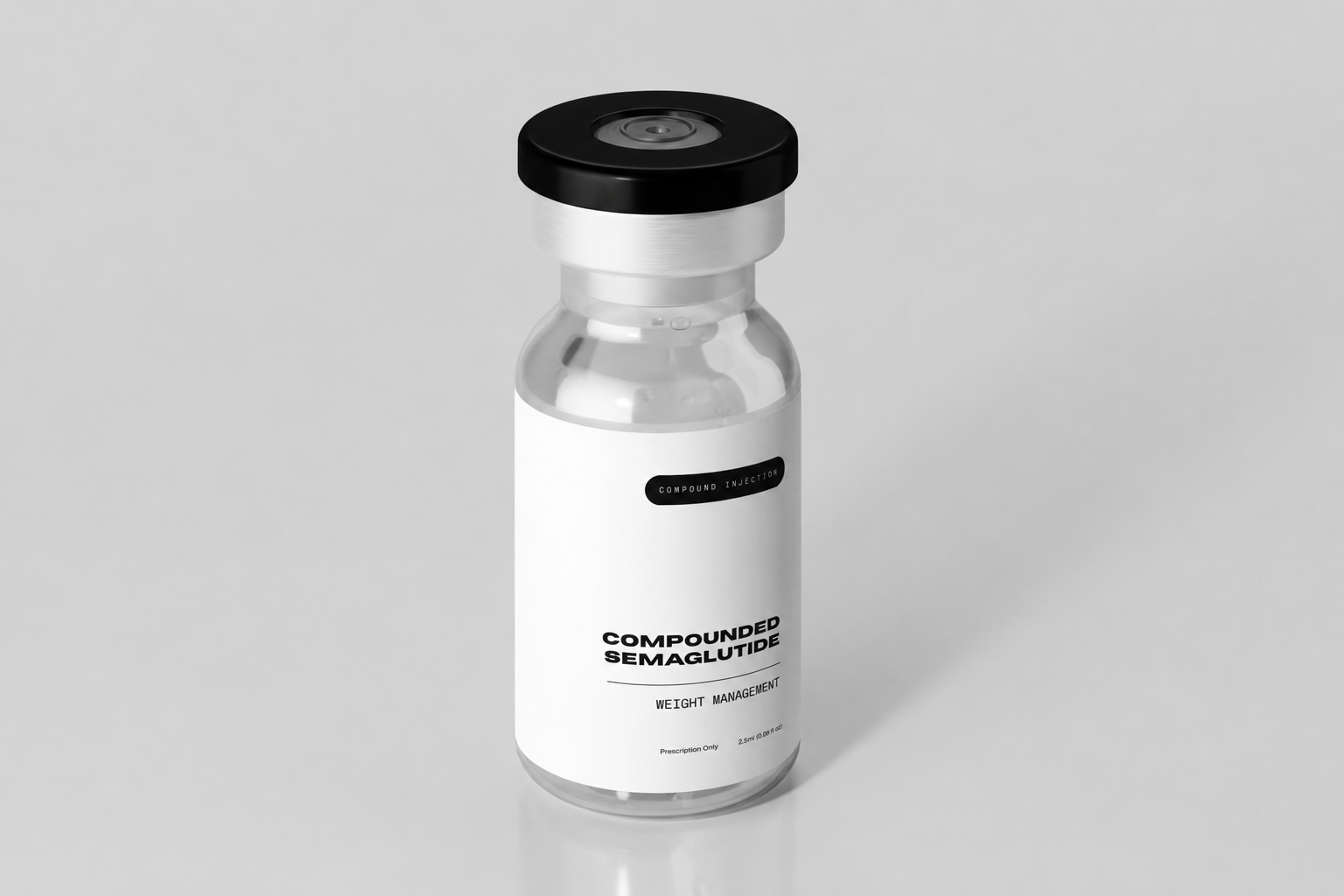

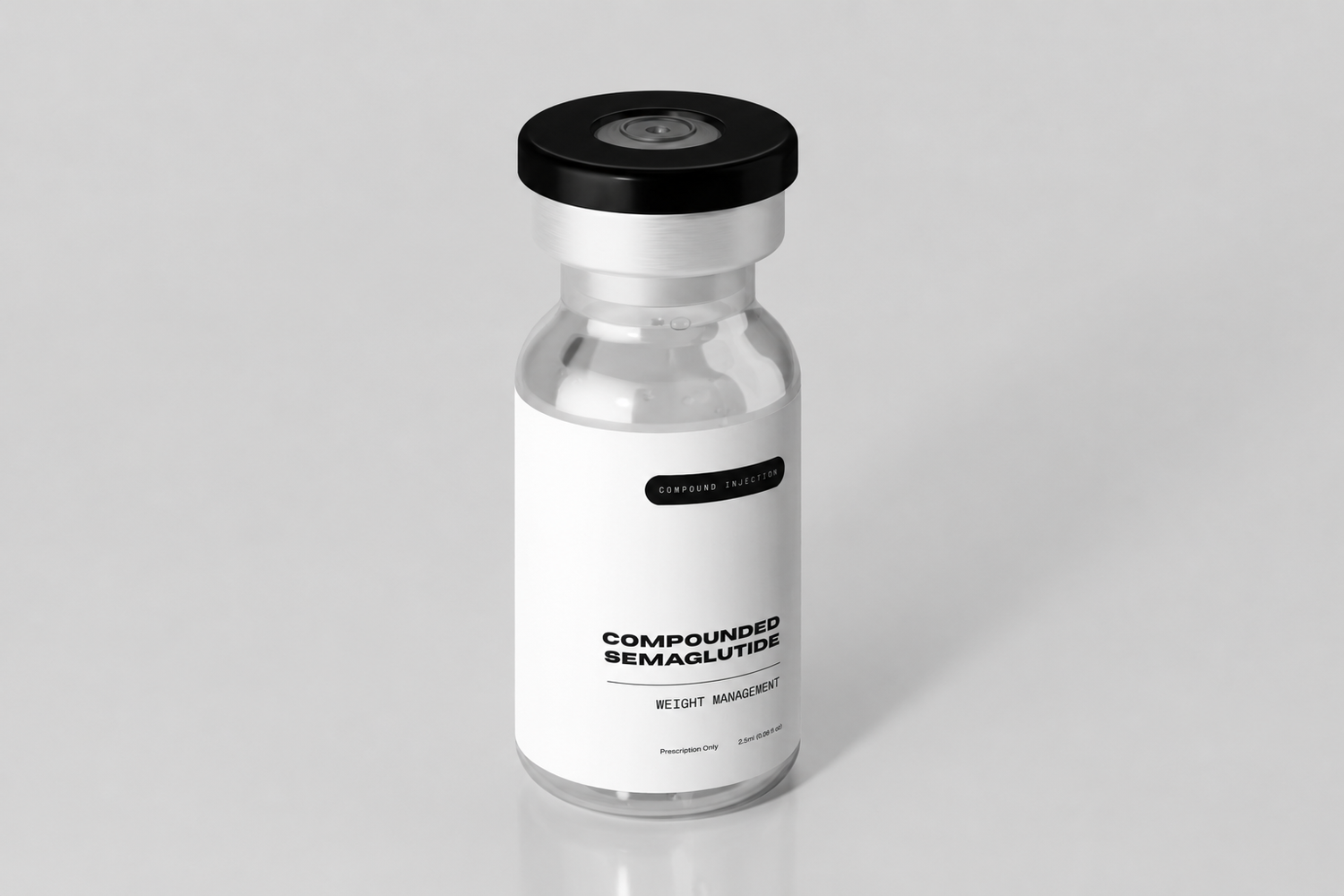
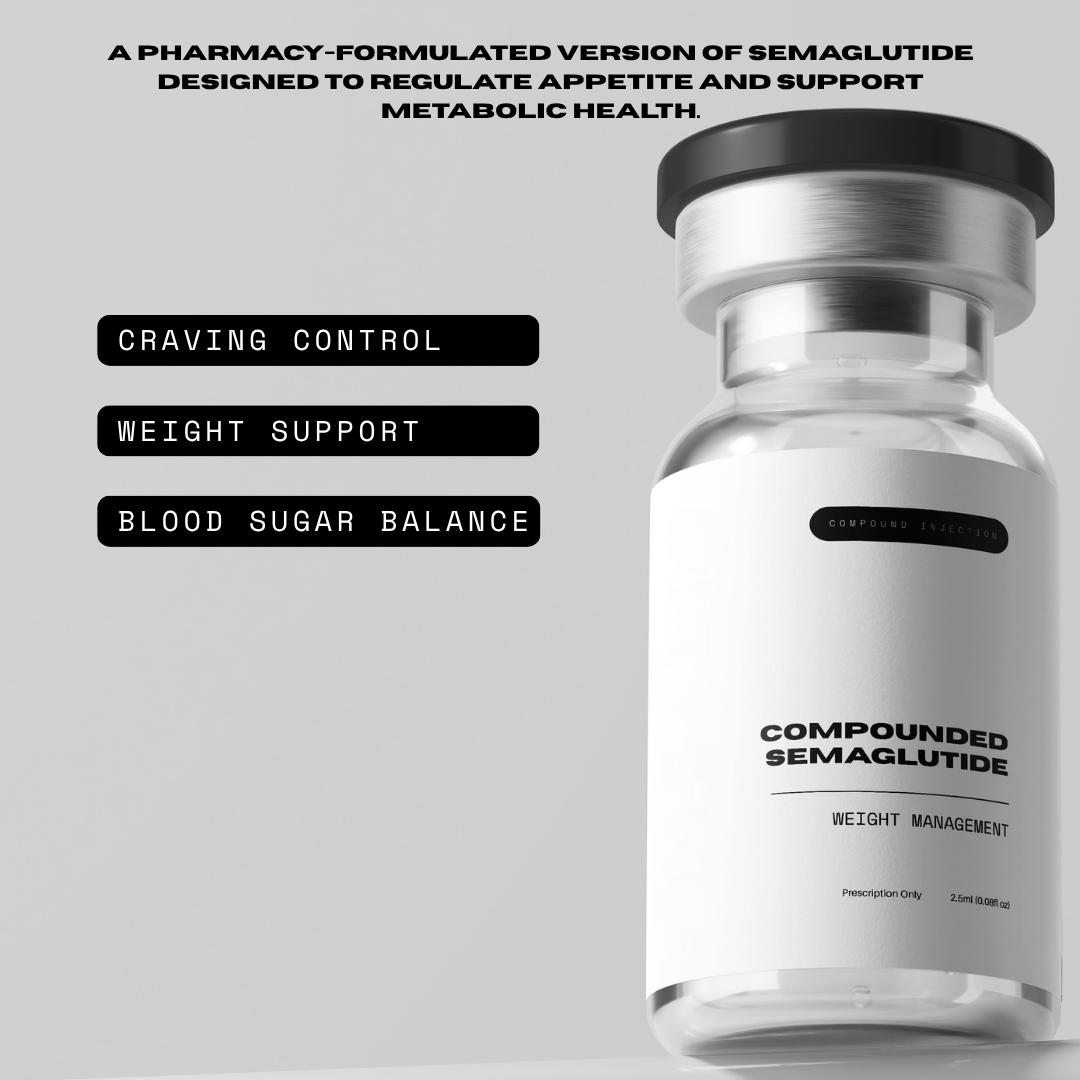
COMPOUNDED SEMAGLUTIDE + B6
- Regular price
-
$219 - Regular price
-
$0 - Sale price
-
$219

Pricing is for a monthly supply. Prescription medication. Medical evaluation required.
What is compounded semaglutide?
Compounded semaglutide is semaglutide prepared by a state-licensed compounding pharmacy for one patient, on one prescription. At Fitish RX it is prepared with vitamin B6.
Semaglutide is a GLP-1 receptor agonist. It acts on the GLP-1 pathway, which plays a role in appetite signals, how quickly your stomach empties, and how your body responds to insulin. It is a once-weekly injection under the skin, started low and stepped up gradually so your body can adjust.
At Fitish RX it is $219 for a monthly supply. That covers your provider consult, the medication if you are approved, and shipping. No membership fee on top.
What it is designed to support
- Medically supervised weight management, paired with nutrition and movement habits
- Steadier appetite and less food noise between meals
- Blood sugar regulation, which is part of how semaglutide works
Results vary from person to person. Your care team tracks how you are responding and adjusts from there.
What to expect
Week one is a low starting dose. That is on purpose. Your dose steps up in stages, and each step is a check-in, not a countdown. The goal is the dose that works for you with side effects you can live with.
The most common side effects are gastrointestinal: nausea, constipation, indigestion. They tend to show up around dose changes and usually ease as your body adjusts. Message your care team in the portal if they do not.
Who it's for
Adults pursuing medical weight management whose BMI and medical history meet clinical eligibility criteria. A licensed Fitish provider reviews every intake before any prescription is issued.
Compounded semaglutide dosage: how it works
Your starting dose and step-up plan are set when a licensed provider reviews your intake, and they live in your patient portal. A few things worth knowing before your first vial arrives:
- Know your units. Compounded semaglutide usually comes in a vial, which means drawing your dose into a syringe. Doses can be written in milligrams (mg), milliliters (mL) or syringe "units," and those are not interchangeable. FDA has specifically flagged mix-ups between these units as a cause of dosing errors with compounded semaglutide. If your label and your instructions do not match in a way you understand, stop and ask before you inject.
- Do not freelance the schedule. FDA has received adverse event reports tied to compounded GLP-1 doses taken more often, in larger amounts, or stepped up faster than prescribed. Stick to the plan in your portal and message your provider before changing anything.
- New needle and syringe every time. FDA recommends a new sterile needle and syringe for every dose.
How to store compounded semaglutide
Fridge, not freezer. Keep it out of light and out of reach of kids and pets. Follow the storage instructions and beyond-use date on your pharmacy label, since those are specific to your vial.
Your Fitish RX semaglutide can handle up to 7 days at room temperature, as long as it never goes above 120°F, per our pharmacy partner. So if the cold packs have melted by the time your box shows up, that is normal: they did their job keeping it cool in transit. Put it in the fridge when it arrives.
If your vial holds more than one dose, FDA recommends throwing it away 28 days after first use, even if there is medication left. If the vial or package arrives damaged, contact us at theclinic@fitish.com and we will sort it out. More storage answers live on our Clinic FAQ page.
How much does compounded semaglutide cost?
$219 for a monthly supply, all in: provider consult, medication if you are approved, and shipping. No insurance needed, no membership fee, no surprise consult charge.
If you are comparing prices, a price that looks too good to be true is on FDA's own list of telehealth red flags. So is a company that skips the medical screening. We do neither.
How Fitish RX works
You complete a short online intake about your health and goals. A licensed provider reviews it, and if semaglutide is a fit, writes your prescription. Your medication ships discreetly from a licensed compounding pharmacy on a monthly cadence. From there, your care team stays with you through the patient portal for dose adjustments, questions, and ongoing support at no added cost.
Important to know
Compounded semaglutide is prepared by a state-licensed sterile compounding pharmacy. Compounded medications are not FDA-approved and do not undergo FDA review for safety, effectiveness, or manufacturing quality. FDA-approved semaglutide products are commercially available. Compounded semaglutide is prescribed only where a licensed provider determines it is clinically appropriate based on your evaluation.
Questions about your label or instructions for use? Ask us or the pharmacy before you inject.
Full dose or microdose: you pick the lane
Fitish RX has two GLP-1 lanes. You choose the one that fits your goal, and a licensed provider reviews your intake and prescribes if it is a fit.
- Compounded semaglutide (full dose), $219 a month. For medically supervised weight management. Starts low and steps up.
- Microdose semaglutide, $179 a month. A gentle, fixed lower dose for people who are GLP-1 curious but do not want the intensity of a full protocol. Think quieter food noise and habit support. It does not step up.
Not sure which lane is yours? Read microdosing semaglutide explained, compare the two side by side in the GLP-1 microdosing chart, or see how it stacks up in semaglutide vs tirzepatide.
Not eligible for the full-dose program? Eligibility is based on BMI and clinical criteria. You may still be a candidate for the GLP-1 Microdosing Program, a gentler lower-dose lane built for wellness and habit support. Choose it at intake and a licensed provider will review whether it fits your health profile.
These statements have not been evaluated by the Food and Drug Administration. Individual results vary. This product is not intended to diagnose, treat, cure, or prevent any disease.
Frequently asked questions
What is compounded semaglutide?
Semaglutide prepared by a state-licensed compounding pharmacy for an individual patient by prescription. Compounded medications are not FDA-approved. A licensed provider reviews your intake to decide whether it is appropriate for you.
How much does compounded semaglutide cost at Fitish RX?
$219 for a monthly supply, including your provider consult, the medication if you are approved, and shipping. No membership or consult fees on top.
How is compounded semaglutide dosed?
Once a week, as an injection under the skin. You start at a low dose and step up in stages based on how you respond. Your plan is set by your provider at intake review and lives in your patient portal. Doses can be written in mg, mL or syringe units, so confirm you understand your label before your first injection.
How do I store compounded semaglutide?
In the fridge, never the freezer, away from light. Follow the beyond-use date and storage instructions on your pharmacy label. It can handle up to 7 days at room temperature as long as it stays under 120°F, so melted cold packs on arrival are normal. If your vial holds multiple doses, FDA recommends discarding it 28 days after first use.
Do I need insurance?
No. Fitish RX is direct-pay telehealth with transparent, all-in pricing. You do not need to involve insurance.
Can I pay with my HSA or FSA?
Sometimes. Some plans and cards will go through and others will not, and that part is largely outside our control. Card networks currently treat compounded telehealth prescriptions inconsistently, so an HSA or FSA card can be declined at checkout even when your plan would otherwise allow the expense. Eligibility is determined by your plan and your plan administrator, not by us. If you want to use those funds, the most reliable route is to check with your administrator first, pay with any other card, and submit for reimbursement. Your provider can issue a Letter of Medical Necessity to support that request.
What are the most common side effects?
Gastrointestinal effects like nausea, constipation and indigestion are the most common, and they usually ease as your body adjusts. Your provider reviews the full safety profile, including the boxed warning, with you before you begin.
What if I do not qualify for full-dose semaglutide?
You can choose the GLP-1 Microdosing Program at intake. A licensed provider reviews whether it fits your health profile.
What happens if I stop taking compounded semaglutide?
In large trials of FDA-approved GLP-1 medications, most people regained a meaningful share of the weight they lost within a year of stopping. In one trial, pairing a GLP-1 with regular exercise helped people keep more of their results after stopping, so the habits you build while you are on treatment matter. Read what happens when you stop taking a GLP-1, and talk to your provider before you stop or change your dose.
New to GLP-1? Read our guide to weight loss shots and how they work.
For more detail, see The Clinic FAQ page or our Fitish RX Safety Information. The boxed warning, full side effect list, and drug interaction details remain in the Safety Details section below. Report side effects to FDA MedWatch at fda.gov/medwatch or 1-800-FDA-1088.
More
Semaglutide is a GLP-1 receptor agonist medication. Compounded semaglutide is custom-prepared by a state-licensed compounding pharmacy based on a prescription from a licensed provider. Compounded medications are not FDA-approved and are not reviewed by the FDA for safety, effectiveness, or quality. State-licensed compounding pharmacies follow both federal and state regulations, including quality standards.
FAQ
Safety Details